
Who you're actually overpaying
Not the street vendor, the motorbike taxi or the family-run guesthouse. The extra you pay in Thailand mostly goes to big operators: airport exchange counters, banks, mobile network operators and entertainment platforms. You don't need to haggle. You need to ask for the right thing.
- Ask for the meter
- Ask to pay in Thai baht
- Ask for the pier price
We spend a lot of our time in Thailand with locals, and most of what's in the guide we learned from them. They know exactly where tourists overpay, and they're usually happy to tell you.
What our readers pay
Same services. A lot less money.
| Service | Regular price | With the guide | You save |
|---|---|---|---|
| All seven, per year |
Regular prices are standard UK prices; the mobile SIM is the 30-day tourist SIM sold on arrival. Yearly figures are 12 months of each subscription, and for mobile data, twelve 30-day tourist SIMs against our 12-month insider plan. Our insider 12-month data plan includes 100GB a month rather than unlimited data (the 3-month plan used for the monthly view includes 50GB a month), which is plenty for most trips. Converted at rates from 16 October 2026. How to get each price is in the guide.
The guide
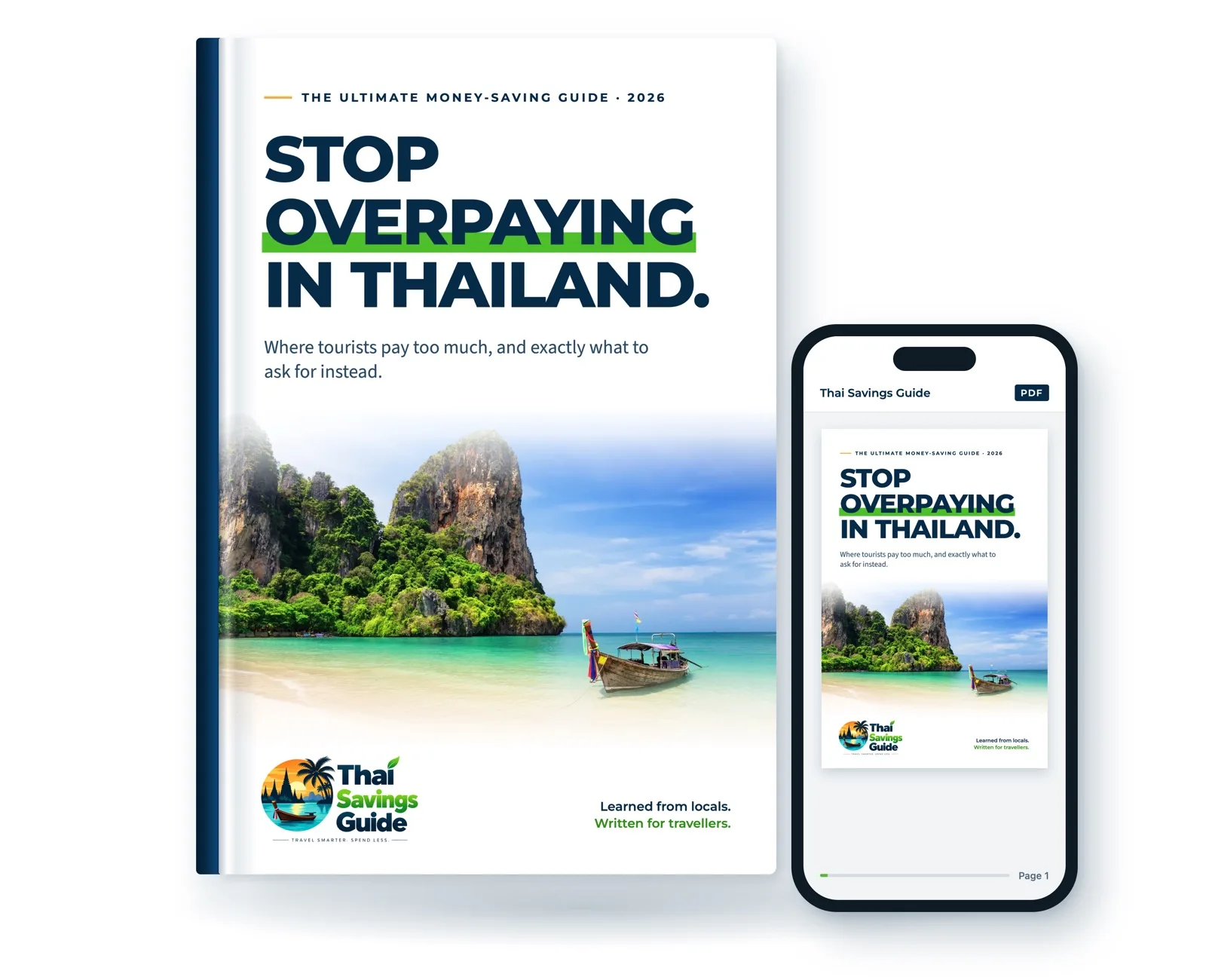
The Thai Savings Guide
Everything we've learned about not overpaying in Thailand, in one place. The two biggest savings come first: mobile data and your subscriptions at local prices. Then where the other mark-ups are, what to say instead, the exact places to go, and how to pay like a local without carrying cash. Read it on the plane and you'll be ready before you land. We update it regularly with the best new tips, so the prices and tricks stay current.
Mobile data for half the price, or less Biggest saving
The plans locals use, whether you're here for a few weeks or a whole year. Example: 12 months with 100GB every month for about £62 a year, instead of £323 on tourist SIMs.
Subscriptions at local prices Big saving
Spotify, Netflix, Disney+, Amazon Prime and more for up to 74% less. Spotify Premium for £3.34 a month instead of £12.99.
Ride & delivery apps Saves daily
Cheaper rides and food with Grab, Bolt and more, how to tell which one is cheapest for each trip, and how to stop paying a foreign card fee on every ride and order.
Cheaper flights Saves on every booking
The one setting on airline websites that can lower the fare on flights within Thailand, and how to pay without currency conversion fees.
Money & cards
Where to change cash, which ATMs to use, and the card settings that matter.
Pay like a local
The digital payment locals use with street vendors and in shops, even where there's a card minimum. No minimum spend, no limits, and no foreign card fees on ride and food delivery apps.
Arriving
Airport to city without the taxi-rank markup, from Suvarnabhumi, Don Mueang and Phuket.
Getting around
BTS, MRT, taxis, trains and buses, and how to cut journey times in peak season.
Food & drink
Why street food is already fair, and where the real mark-ups are.
Islands & ferries
Pier prices, tour desks, and what's actually included in a day trip.
Scams & tourist traps
The ones still doing the rounds, and the ones that are mostly folklore.
Pays for itself in the first month. Readers save around £50 a month on the services above.
Secure checkout through Gumroad. You'll get the download link straight away, and by email.
What Thai ATMs add to every withdrawal on a foreign card, depending on your card. Why it varies. The guide shows how to pay like a local instead.
What tourists typically overpay getting from Suvarnabhumi into Bangkok. The guide shows the cheaper way.
Bangkok taxis start at 35 ฿. The meter is the standard fare, and most drivers use it without fuss.
When a card machine offers your home currency, say no. The "convenience" rate costs you. How to spot it.
Where the money goes
Where tourists overpay.
None of this means haggling with a vendor over 20 baht. These are charges big operators add because they expect tourists not to know better. Two fixes are free below. The rest are in the guide.
| Situation | What most people do | The fix | Typical overpay |
|---|---|---|---|
| Paying by card | Accept the offer to pay in pounds, euros or dollars | Always choose Thai baht and let your card do the conversionFree tip | Often 3–8% |
| Short taxi rides | Agree a fixed price before getting in | Ask for the meter. It's the standard fareFree tip | Varies by trip |
| Suvarnabhumi to the city | Taxi from the rank, plus the 50 ฿ airport surcharge and tollsUsually 300–450 ฿ to Sukhumvit | In the guide: Arriving | 250–350 ฿ |
| Changing cash | Arrivals-hall exchange counter, the whole lot at once | In the guide: Money & cards | A few % of everything |
| Paying vendors and small shops | Pay ATM fees for cash, or spend extra to reach a card minimum | In the guide: Pay like a local | 250–350 ฿ per withdrawal |
| Rides and food delivery | Use one app for everything, accept its price, and pay with a card from home, adding a foreign card fee to every ride and order | In the guide: Ride & delivery apps | Adds up every day |
| Peak-season travel | Travel at the same times as everyone else | In the guide: Getting around | Hours, not just baht |
| Cash withdrawals | Small withdrawals every couple of days | In the guide: Money & cards | 250–350 ฿ each time |
| Island day trips | Book the package at the hotel desk | In the guide: Islands & ferries | Often hundreds of baht |
Figures are typical for Bangkok and were last checked October 2026. Prices move, so every figure in the guide carries the date we checked it.
From the islands chapter
Before you book an island day trip
Tour desks aren't a scam, but the price on the board often includes things you didn't ask for. Ask these four questions first. The guide covers what the answers should be, and our national park fees article lists what each park charges.
- Is the national park fee included, or paid on the day?
- Could you buy the boat ticket at the pier yourself?
- Speedboat or longtail, and how many people per boat?
- What happens to your money if the sea's too rough to go?
How we work
Why you can trust a figure in the guide.
-
We're not here to squeeze locals
We'll never tell you to haggle a food stall down by 10 ฿. The savings we write about come from big businesses that charge tourists more because they can. Plenty of our best tips came from locals in the first place.
-
Every price has a date
Thailand changes quickly. If we haven't rechecked something recently, the guide says so.
-
We pay our own way
No free stays in exchange for reviews. If a link earns us a commission, it's labelled next to the link.
-
Cheapest isn't always best
Sometimes the extra 200 ฿ buys you two hours back. When it does, we'll tell you to spend it.
Free to read
Read before you go.
Dated, sourced articles on what things cost in Thailand. The guide goes further, with the step-by-step fixes.
- Costs
What Thailand Really Costs in 2026, in Pounds
Daily costs by region and travel style, with the fees most budgets miss.
- Money
The 250 and 350 Baht Question: Thai ATM Fees, Explained Properly
Why the fee depends on your card, and how to keep the cost of cash to around 1 per cent.
- Money
Say No to the Conversion
The two-second habit at ATMs and card machines that saves 3 to 8 per cent.
- Money
Where the Money Leaks: Thailand's Real Tourist Premiums
The four places most visitors overpay without noticing.
- Destinations
Phuket Without Overspending
Where to stay, the airport bus, boat days and what tour prices leave out.
- Fees & rules
Thailand's New Travel Fees, Tracked
The departure tax and tourist fee: what's proposed and what's law.
Questions
Before you buy.
What format is the guide?
A PDF. It works on any phone, tablet or laptop, and you can read it offline once it's downloaded.
How much does it cost?
£14.99, paid once through Gumroad's secure checkout.
How do I get it after paying?
Gumroad shows you a download link straight away and emails it to you as well.
Is the guide kept up to date?
Yes. We update it regularly with new tips, and every price in it carries the date we last checked it.
Is this about haggling with locals?
No. The savings come from big operators that charge tourists more: airport exchange counters, banks, tourist SIMs and packaged tours. We never suggest haggling with street vendors or small businesses.